


Platform overview: PowerEdge R550
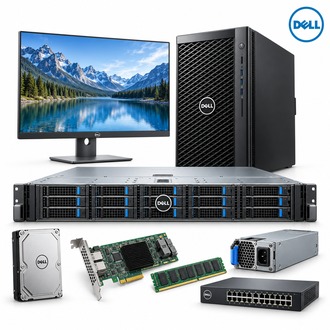
PowerEdge R550 is a Dell two-socket rack-server platform intended for configurable compute and storage workloads. The final system capability depends on the installed processor pair, memory population, drive chassis, storage controller, network adapters and power-supply selection. This page uses a shared Dell reference image rather than a photograph of a specific PowerEdge R550 configuration.
Configuration checkpoints
| Selection point | Specification / confirmation |
|---|---|
| Exact model | PowerEdge R550 |
| Platform | Dell PowerEdge R550 rack server |
| Processor | Up to two 3rd Generation Intel Xeon Scalable processors |
| Memory | 16 DDR4 DIMM slots; registered ECC DIMMs |
| Drive options | Chassis options include 2.5-inch and 3.5-inch SAS/SATA configurations |
| Storage controllers | Supported choices include PERC H345/H355/H745/H755 and HBA355i |
| Power | Power-supply options vary; check input voltage and redundancy requirements |
Build the server around the workload
For PowerEdge R550, size processor and memory resources against the application, then select drive bay layout, disk type and RAID or HBA mode to meet capacity and recovery targets. Confirm the selected backplane and controller are compatible as a complete set. Check rack depth, rail kit, power feeds and airflow before deployment of PowerEdge R550.
- Match CPU and DIMM specifications to the intended workload.
- Confirm drive count, carrier, backplane and controller together.
- Plan redundant power, network links and management connectivity.
- Validate firmware, supported operating system and backup procedure.
Commissioning record for PowerEdge R550
Record the service tag, firmware baseline, processor, memory map, storage layout, NIC ports, PSU type and rack location for PowerEdge R550. Test remote management, alert delivery, network paths and a sample recovery before handing the server over. List the exact model PowerEdge R550 with its approved bill of materials on the purchase record.
Use PowerEdge R550 as the platform key for later parts selection, firmware planning and lifecycle support.
