


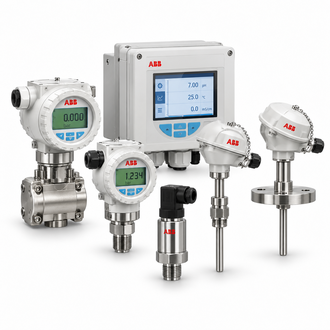
PDS300.F.S9.A.1.A.H.1.B.H: PDS300 differential transmitter: sensor span, process connection and impulse-line planning
The ABB PDS300.F.S9.A.1.A.H.1.B.H is a PDS300 differential-pressure transmitter configuration. ABB describes PDS300 for flow, pressure and level measurement, with a base-accuracy reference of ±0.055% of calibrated span. The family covers a broad span range, but sensor code, overpressure limit, wetted materials and options must be confirmed from the exact configuration record.
Key technical data
| Technical item | Verified value / selection note |
|---|---|
| Representative designation | PDS300.F.S9.A.1.A.H.1.B.H |
| Measurement | Differential pressure for flow, pressure or tank-level applications |
| Base accuracy | ±0.055% of calibrated span family reference |
| Family span limits | 0.2 to 60,000 kPa; sensor and code determine the selected range |
| Overpressure capability | Sensor-specific; some ranges list up to 21 MPa |
| Features | Backlit display, optional Bluetooth and diagnostic functions by version |
| Exact configuration | Verify seals, process materials, output and approvals |
The table summarizes family or catalog values for identification and initial selection. Confirm the nameplate, environmental limits, standards, revision and options for the exact device before procurement or engineering approval.
Application and system selection
For flow service, coordinate the transmitter with the primary element and expected differential-pressure range. For tank level, account for static head, density and reference-leg conditions. Impulse lines, manifolds, condensate pots and seal systems influence response and measurement error and must be engineered for the process environment.
Configuration and compatibility
Check the complete PDS300 code for sensor, process flange, materials, display, output, Bluetooth, approvals and accessories. Use the actual operating pressure and temperature when verifying overpressure and static-pressure limits. Avoid extrapolating a family maximum to an individual code or process connection.
Related models and order-code references
The following designations are related catalog references, not automatic substitutes. Check each complete code, rating, connection, revision and application requirement before selecting a variant.
- PDS300.F.S9.A.1.A.H.1.B.H-.D1
- PDS300.F.S9.A.1.A.H.2.A.H-D1.BA.CF
- PDS300.H.S9.A.1.A.A.2.A.H-.D1.HAA.BC.CF.CW
- PDS300.M.S9.A.1.A.A.2.A.H-.D1.HAA.BC.CF.CW
- PDS300.N.S9.A.1.A.A.2.A.H-.D1.HAA.BC.CF.CW
- PDS300.N.S9.H.1.A.H.1.T.H-VA.D1.HAA.BA.LES.M5
Installation and commissioning
Mount the transmitter with high/low ports oriented correctly and use a rated manifold to isolate and equalize safely. Leak-test and flush impulse lines as appropriate, configure units and calibrated span, then verify zero and output at known pressure points. Validate the control-system scaling and diagnostic status before enabling automatic control.
Replacement and procurement information
For a quotation or replacement review, provide the complete designation PDS300.F.S9.A.1.A.H.1.B.H, the order code where applicable, serial or hardware revision, quantity, operating environment, connected equipment and required delivery date. Include a legible nameplate image and relevant wiring, loop or switchgear drawing so the exact interface and configuration can be checked.
Ask the supplier to confirm accessories, revision compatibility and any approved successor in writing. Do not select solely from a family name or product photograph. Follow the current ABB installation and safety instructions for the exact unit.
