


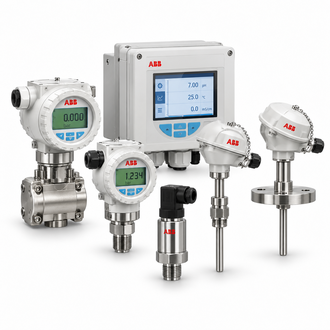
266HSH high-overload gauge pressure transmitter: range, accuracy and code checks
ABB 266HSH is a high-overload gauge pressure transmitter family for liquid, gas or steam pressure and open-tank level measurement. The requested designation is 266HSH.E.S.B.B.7.E1.LS.R1.B7. Its option positions are configuration-specific; decode the calibrated range, process connection, wetted materials and communication option from the nameplate and matching ABB configuration documents rather than inferring them from the prefix.
Key technical data
| Technical item | Verified value / selection note |
|---|---|
| Complete designation | 266HSH.E.S.B.B.7.E1.LS.R1.B7 |
| Family | ABB 266HSH high-overload gauge pressure transmitter |
| Measurement | Gauge pressure; family applications include pressure and open-tank level |
| Family span limits | 16 to 105,000 kPa (16 kPa to 105 MPa); configured range depends on variant |
| Maximum working pressure | Up to 105 MPa for the family; verify specific unit and process limits |
| Base accuracy | From ±0.06% as a family-level value; confirm conditions/options |
| Communication choices | HART, PROFIBUS PA, FOUNDATION Fieldbus and WirelessHART family options; verify fitted protocol |
| Exact range/connection/materials | Not decoded here from suffix alone; verify nameplate and ABB configuration record |
These figures describe family capabilities, not a claim that every option is fitted to this suffix. Range, output, connection, diaphragm/seal materials, hazardous-area approval, display and accessories must be checked against the instrument’s own ordering record.
Measurement duty and range selection
A gauge transmitter measures process pressure relative to local atmospheric pressure. The high-overload family capability is not the calibrated span and does not authorize exceeding the rating of the installed configuration. For open-tank level, account for liquid density, mounting elevation, impulse/seal arrangement and geometry.
Select a calibrated span that covers normal operating pressure while retaining suitable accuracy and margin for transients. Review static pressure, surge, temperature, fluid compatibility and the pressure code applicable to the plant. Check whether the application needs direct mounting, remote seal, diaphragm protection or capillary, and consider elevation effects where seals are used.
Confirm pressure port and manifold arrangement, vent/drain orientation, impulse-line routing and condensate behavior. Gas, liquid and steam services can require different installation practices. Ensure the transmitter range and units agree with DCS/PLC scaling, alarm setpoints and operator displays before commissioning.
Communication and configuration
The family supports several communication choices, but the complete ordering code identifies the device actually supplied. For analog HART, verify loop supply, load, polarity, scaling and host configuration. For PROFIBUS PA or FOUNDATION Fieldbus, check segment power, address, device description and host support. A WirelessHART version requires compatible network planning and power/battery checks.
Do not infer output, electrical entry, wetted materials, connection, hazardous-area approval, display or remote-seal option from a visually similar suffix. Compare the nameplate with original datasheet and loop documentation. If the order code is incomplete or reformatted, have ABB or an authorized specialist decode it before replacement.
Other 266HSH configuration references
The codes below share the 266HSH family prefix but have different option strings. They are not interchangeable by default. Check range, protocol, process connection, materials, approvals, display and accessories for each complete designation.
- 266HSH.H.S.B.B.7.E1.LS.R1.B7
- 266HSH.M.S.B.B.7.E1.LS.R1.B7
- 266HSH.P.S.B.B.7.E1.LS.R1.B7
- 266HSH.Q.S.B.B.7.E1.LS.R1.B7
- 266HSH.Q.S.T.A.7.E1.LS.R1.B6
- 266HSH.Q.S.T.B.7.E1.LS.R1.B7
- 266HSHSKBA1L1B7
- 266HSH-P-K-B-B-1-E1-L1-B6-H4
- 266HSH-P-S-B-A-7-E1-LS-R1-B7-H3
- 266HSH-Q-S-B-A-7-E2-LS-H3
- 266HSH-S-K-B-T-1-E1-L1-B7-H4
- 266HSH.E.K.T.B.1.E1.L1
- 266HSH.E.S.B.A.1-L1.B7.I2
- 266HSH.E.S.B.A.1-1.B7.I2
- 266HSH.G.S.B.A.1.E2.L1.B6
- 266HSH.H.S.B.A.1-L1.B7.12
- 266HSH.H.S.B.A.1-L1.B7.I2
- 266HSH.H.S.B.B.1-EY.L1.B6.I1.H3
- 266HSH.M.K.P.A.1
- 266HSH.M.S.B.A.1-L1.B7.12
- 266HSH.M.S.B.A.1-L1.B7.I2
- 266HSH.M.S.B.B.3-EY.L1.B6.I1.H3
- 266HSH.M.S.T.S.7.LS.B7.I2.H3
- 266HSH.P.K.B.B.7.E2.B7.H3
- 266HSH.P.S.B.A.1-L1.B7.12
- 266HSH.P.S.B.A.1-L1.B7.I2
- 266HSH.P.S.B.A.1.L5.B2.T3.I2.N6.C1
- 266HSH.P.S.B.A.1.VA.E1.B7.M5.I2
- 266HSH.P.S.B.A.7-LS.B6
- 266HSH.P.S.B.B.3-EY.L1.B6.I1.H3
- 266HSH.P.S.B.B.7.E1.L1.B7.I2.H3
- 266HSH.P.S.B.B.7.E1.LI.B7.12.H3
- 266HSH.P.S.T.S.7.LS.B7.I2.H3
- 266HSH.P.S.T.T.8.E2.L1.I2.C5.H3
- 266HSH.Q.M.1.B.1-EY.L1.B6.I1.H3
- 266HSH.Q.S.B.A.7-LS.B6
- 266HSH.Q.S.B.B.1
- 266HSH.Q.S.B.B.1.E1.L1.C1.H3
- 266HSH.Q.S.B.B.3-EY.L1.B6.I1.H3
- 266HSH.Q.S.B.B.7.E1.L1.B7.I2.H3
- 266HSH.Q.S.B.B.8.E1.L1.B7.M5.I3.C5
- 266HSH.S.K.B.A.1.E1.L1.B6.I2.C1.H3
- 266HSH.S.S.B.A.1.VA.E8.S2.M5
- 266HSH.S.S.B.A.7-E9.LS.B7.I2
- 266HSH.S.S.B.B.1.E2.L1.B7.I2.C6
- 266HSH.S.S.B.B.3-EY.L1.B6.I1.H3
- 266HSH.S.S.T.A.7-E2.LS.S2.C1.C5.H3 (160BAR)
- 266HSH.V.K.E.B.1.VB.E1.L1.B7.M5.N5.C1
- 266HSH.W.K.T.B.7.EN.LS.H3+ A2VM RMFSS
- 266HSHESBA7LS
- 266HSHESTA7
- 266HSHGSBA7/L9/B6
- 266HSHGSBB7E6L9I3C1H3A1
- 266HSHHSBA7EZLSB6AB
- 266HSHHSTB1 E1/L1/M5
- 266HSHMSBA3
- 266HSHMSBA7/L9/B6
- 266HSHMSBA7/LS/B6
- 266HSHMSTA7
- 266HSHMSTT1VA.EN. L1.B7.I2.C1.H3
- 266HSHPKBA1E6L1B7I1C5C1H3
- 266HSHPSBA1-E9L1B7+S26RA.H.E1.S.F.HM.2.B.J.S.N.N.N
- 266HSHPSBA1-VAL1B7
- 266HSHPSBA1VAE1L1
- 266HSHPSBA7-LSR1B6
- 266HSHPSBA7E6LSB6R1I2
- 266HSHPSBB7E1R1B6I2
- 266HSHPSBT8E2L1B7I2C1
- 266HSHQSBA1-VAL1B7
- 266HSHQSBA1E2B7I2C5H3
- 266HSHQSBA1E2L1B7I3C5H3
- 266HSHQSBA7
- 266HSHQSBA7E1R1I2C1
- 266HSHQSBB1E1L1C1C5H3
- 266HSHQSBB3E1L1S2I2C1C5H3
- 266HSHQSBT8-E2L1B7M4T4I2C1H3
- 266HSHSKBB1E2L1B6S2T4I1C1H3
- 266HSHSSBA7LSB6TB
- 266HSHSSBB1E1L1C1C5H3
- 266HSHSSBB7E2LSR1B6I2
- 266HSHWKET1-E1L1B7I2
- 266HSH.E.S.B.B.7.E.1.LS.R1.B7
- 266HSH.Q.S.B.B.7.ELLI..B7.12.H3
Installation and commissioning
Plan process isolation and depressurization before removal. Check manifold position, pressure-port cleanliness, seals, mechanical support and orientation. Install using the approved procedure and protect the sensing element from overpressure, vibration, water ingress and temperatures beyond the selected variant’s limits. Apply hazardous-area controls where relevant.
At commissioning, confirm lower/upper range values, units, output mode and control-system scaling. Check zero under the proper equalized condition and verify the loop against an approved pressure source or functional test. Do not use arbitrary trim to mask a blocked impulse line, elevation error, manifold leak or installation fault. Preserve as-found and as-left values.
For safety-related or regulated service, use the certificate and safety manual for the exact device/configuration. Verify proof-test interval, diagnostics, installation constraints and change-control requirements with the responsible safety engineer. A family-level statement does not certify every configured instrument for every loop.
Replacement and quotation checklist
Send complete code 266HSH.E.S.B.B.7.E1.LS.R1.B7, serial number, nameplate photo, calibrated range and units, process connection, wetted parts, electrical entry, protocol, approvals, display/accessories, process medium, pressure/temperature limits, quantity and destination. Include the datasheet, loop sheet or commissioning record when available.
Request written confirmation of the order-string interpretation and exact variant. For hazardous-area or safety loops, verify certification scope, proof-test requirements and project approval before installation. Keep the confirmed code and final configuration settings with the maintenance record.
