


ACS150-01-04A7-2 micro drive: supply, motor rating and installation review
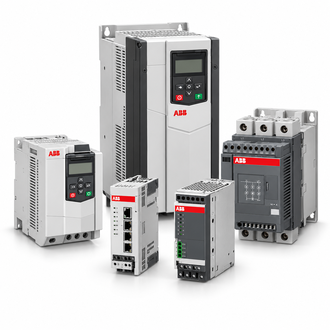
ABB ACS150-01-04A7-2 is a compact micro drive for basic variable-speed applications. The -01 designation identifies a single-phase supply version. Read the complete type code from the drive rating label before selecting a replacement. The category image is illustrative, not a model-specific photograph.
Key technical data
| Technical item | Verified value / selection note |
|---|---|
| Type code | ACS150-01-04A7-2 |
| Family | ABB ACS150 micro drive |
| Input supply | 1-phase, 200–240 V AC; verify nameplate and manual limits |
| Rated output current | 4.7 A for the 04A7 version |
| Typical motor output | 0.75 kW / 1 hp at the specified 230 V supply; verify load and derating |
| Enclosure | IP20 family rating; confirm exact installation conditions |
| Control method | Scalar control for basic speed regulation |
| Family functions | Local interface/potentiometer, built-in brake chopper and EMC filter; verify code/version documentation |
These ratings are a starting point for selection. Confirm motor suitability, ambient and altitude derating, protective devices, braking needs and EMC requirements from the exact product documentation.
Type code and motor matching
The code distinguishes the single-phase model from three-phase ACS150 variants. Its 04A7 current designation is not sufficient by itself: input phase, voltage class, output current, motor voltage, overload duty, enclosure and regional variant must all match. Similar-looking ACS150 codes can have different supply and power ratings and are not interchangeable based only on the family name.
Compare drive output current with motor nameplate current, allowing for temperature, altitude and switching-frequency derating where applicable. Verify motor voltage and frequency, load inertia, starting torque, low-speed cooling, acceleration/deceleration and required speed limits. A fan or pump may have a different load profile from a conveyor or machine tool.
Application and integrated functions
ACS150 is designed for basic speed control in compact applications such as small fans, pumps, conveyors and simple machines when the load fits the drive’s capability. Determine whether the job needs high starting torque, continuous low-speed operation, frequent reversal, regenerative energy handling, safety functions or fieldbus communication. Such requirements may need added engineering, accessories or another drive family.
A built-in brake chopper does not mean a braking resistor is included or automatically suitable. Confirm resistor sizing and thermal protection using ABB instructions. Likewise, check whether the EMC filter configuration matches the site’s earthing system and EMC environment; a family feature is not a site compliance approval.
Related ACS150 designations
The following codes belong to the ACS150 family but may differ in current, phase, voltage and power. They are references only, not confirmed substitutes for ACS150-01-04A7-2.
- ACS150-01E-04A7-2
- ACS150-03E-01A9-4
Panel installation and commissioning
Install in a clean, ventilated enclosure and observe manual clearances and orientation. Check ambient temperature, altitude, contamination, cable entry and heat dissipation. Bond protective earth correctly, separate power and control wiring as required, and use screened motor cable and EMC practices suited to the installation. Do not obstruct cooling paths or expose the drive to heat beyond its limits.
Before energizing, follow isolation and DC-link discharge precautions. Verify supply phase and voltage, protection, motor connections, earthing and control wiring. Enter motor nameplate data, set speed limits and ramps, then verify command/reference sources, direction and stopping behavior under controlled conditions. Record parameters and confirm the machine safety circuit independently.
Replacement and sourcing information
For an exact replacement enquiry provide ACS150-01-04A7-2, serial/product revision, incoming supply, motor nameplate, wiring diagram, speed range, load type, environment and accessories. Preserve the fault history and parameter backup before removing a failed unit when safe.
Do not select by horsepower alone. Confirm current, voltage class, overload capability, frame size, EMC configuration and accessory compatibility against the connected motor and duty. Check parameter migration, firmware and upstream/downstream equipment before commissioning.
